
Introduction
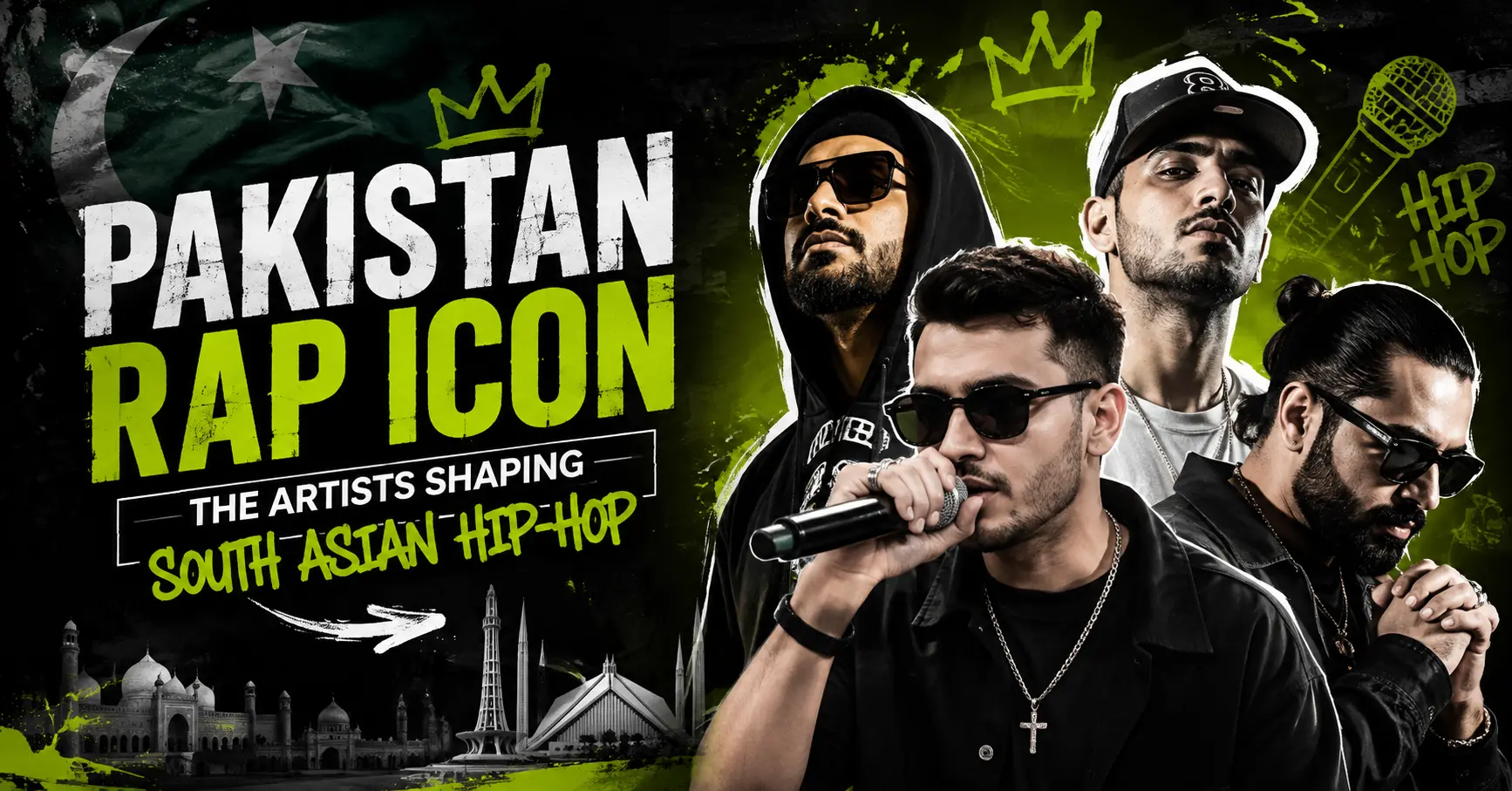
Pakistan rap icon represents more than a successful rapper. It describes an artist who has made a noticeable impact on Pakistani hip-hop through distinctive lyrics, cultural identity, musical innovation, or a strong connection with listeners. From underground cyphers to streaming platforms and social media, Pakistani rap has developed into an important part of South Asian popular culture.
For audiences in India, Pakistani hip-hop is particularly interesting because the music often combines Urdu, Punjabi, English, regional expressions, social commentary, storytelling, and modern production. This article explains what defines a Pakistan rap icon, how the country’s rap scene developed, the artists and styles that have shaped it, and why Pakistani hip-hop continues to attract attention across borders.
What Is a Pakistan Rap Icon?
A Pakistan rap icon is an artist whose music, lyrics, personality, and cultural influence have helped shape the country’s hip-hop identity. A Pakistan rap icon can gain recognition through powerful storytelling, memorable songs, independent releases, collaborations, and a strong connection with listeners. The growing popularity of Pakistani rap has also helped these artists reach audiences beyond Pakistan, including listeners across India and other South Asian markets.
A Pakistan rap icon is generally an influential rapper or hip-hop artist whose work has created a lasting cultural, musical, or commercial impact. The label does not necessarily depend on awards or sales alone.
A rapper may become iconic because of:
- Distinctive lyricism and storytelling
- A recognizable voice or flow
- Strong cultural identity
- Influence on younger artists
- Successful independent releases
- Memorable collaborations
- Social or political commentary
- Contribution to Urdu, Punjabi, or regional rap
- A loyal audience across Pakistan and beyond
The term is therefore broader than simply calling someone a popular rapper. An icon usually leaves an identifiable mark on the development of the genre.
How Pakistani Rap Developed

Pakistani hip-hop has grown through several stages. Early artists helped introduce rap and hip-hop ideas to local audiences, while later performers expanded the sound through Urdu and Punjabi lyrics, independent releases, battle rap, collaborations, and digital distribution.
The growth of the internet played an important role. Artists no longer had to depend entirely on traditional music labels or television channels to reach listeners. YouTube, streaming services, social media, and independent music platforms created new opportunities for musicians to publish songs and develop communities.
This digital shift also made it easier for Pakistani rappers to reach listeners in India and other parts of South Asia.
From Underground Music to Mainstream Attention
Hip-hop originally developed largely through independent and underground communities. Local performances, freestyle sessions, cyphers, online videos, and small music projects gave emerging rappers space to experiment.
Over time, successful artists demonstrated that rap could attract a much wider audience.
The result was a broader Pakistani hip-hop ecosystem involving:
- Independent rappers
- Producers and beatmakers
- DJs
- Music-video creators
- Online music channels
- Streaming platforms
- Live-event organizers
- Rap collectives
This ecosystem helped move rap from a niche musical form toward a more visible part of contemporary Pakistani music.
What Makes a Pakistani Rapper Iconic?
Becoming a Pakistan rap icon is not simply about having a large number of views. Long-term influence usually comes from a combination of artistry, originality, consistency, and cultural relevance.
1. Authentic Storytelling
Strong rappers often use personal experiences, local environments, relationships, ambition, social observations, and everyday struggles as creative material.
This makes the music easier for listeners to understand and remember.
A song that communicates a genuine experience can have more cultural value than a track built only around a trend.
2. Strong Lyricism
Lyrics remain one of the foundations of rap.
A skilled rapper can use:
- Wordplay
- Internal rhymes
- Metaphors
- Double meanings
- Punchlines
- Social commentary
- Narrative storytelling
Urdu and Punjabi also provide rich possibilities for rhyme, rhythm, and poetic expression.
3. Cultural Identity
One of the strongest characteristics of Pakistani rap is its ability to combine international hip-hop influences with local culture.
Artists may incorporate:
- Urdu vocabulary
- Punjabi expressions
- Regional languages
- Local references
- Traditional musical elements
- Pakistani social experiences
This combination allows artists to participate in global hip-hop while maintaining a distinct regional identity.
4. A Recognizable Sound
An iconic artist usually develops a sound listeners can identify quickly.
That sound may come from a particular vocal delivery, production style, beat selection, lyrical approach, or combination of genres.
Distinctiveness is especially valuable in an increasingly crowded digital music environment.
Prominent Names in Pakistani Hip-Hop
The rise of every Pakistan rap icon reflects a different part of the country’s hip-hop journey. Some artists have focused on Urdu rap, while others have contributed through Punjabi lyrics, experimental production, or collaborations with singers and producers. This variety has made Pakistani hip-hop more diverse and has given emerging rappers different creative paths to follow.
Several artists have played important roles in the development and visibility of Pakistani rap and hip-hop. Their styles differ considerably, which demonstrates the diversity of the scene.
Bohemia
Bohemia is widely associated with Punjabi rap and is often discussed in conversations about the development of Punjabi hip-hop in South Asia.
His work helped demonstrate how Punjabi could function as a primary language for rap rather than simply appearing as an occasional element in popular music.
His influence extends beyond Pakistan because Punjabi-language hip-hop has a large audience across the region.
Young Stunners
Young Stunners, the Karachi-based rap duo associated with Talha Anjum and Talha Yunus, became a major name in Pakistan’s contemporary hip-hop scene.
Their music helped popularize Urdu rap among younger listeners and demonstrated how independent artists could build substantial audiences through digital platforms.
Their work is also notable for combining personal storytelling, modern hip-hop production, and references to urban life.
Talha Anjum
Talha Anjum has developed a recognizable identity within contemporary Urdu rap.
His lyrics frequently explore ambition, relationships, personal experiences, pressure, success, and urban life. His delivery and songwriting have contributed to the increasing visibility of Urdu hip-hop among younger South Asian listeners.
Talha Yunus
Talha Yunus is another important figure associated with the modern Pakistani rap movement.
His work with Young Stunners has contributed to the growth of Urdu rap and helped establish a stronger connection between Pakistani hip-hop and the wider digital music audience.
Faris Shafi
Faris Shafi is known for energetic delivery, unconventional presentation, and collaborations across the Pakistani music industry.
His style demonstrates that Pakistani rap does not have to follow one fixed formula. Rap can intersect with pop, alternative sounds, electronic production, and other contemporary genres.
Pakistani Rap vs Indian Rap

Pakistani and Indian hip-hop scenes have developed independently, but they share several cultural and linguistic connections.
| Feature | Pakistani Rap | Indian Rap |
|---|---|---|
| Major languages | Urdu, Punjabi, English and regional languages | Hindi, Punjabi, English and regional languages |
| Common themes | Identity, ambition, relationships, society and urban life | Identity, society, ambition, local culture and personal experiences |
| Digital growth | Strong influence from YouTube and streaming | Strong influence from YouTube, streaming and independent releases |
| Cultural influence | Pakistani urban culture and regional traditions | Diverse Indian regional cultures |
| Sound | Wide range from underground rap to commercial hip-hop | Wide range from underground rap to mainstream hip-hop |
The comparison should not be treated as a competition. Both scenes contribute different perspectives to South Asian hip-hop.
For Indian listeners, Pakistani rap can provide an interesting perspective because Urdu and Punjabi create linguistic and cultural connections while the artists bring their own experiences and production styles.
Why Pakistani Rap Appeals to Indian Listeners
There are several reasons Pakistani hip-hop can resonate with listeners in India.
Shared Linguistic Connections
Urdu and Hindi have substantial linguistic overlap in everyday vocabulary, while Punjabi is widely understood across parts of northern India.
As a result, listeners can often connect with lyrical themes without needing extensive translation.
Similar South Asian Experiences
Many songs explore themes that are not limited to one country.
These can include:
- Family expectations
- Career pressure
- Relationships
- Friendship
- Ambition
- Financial challenges
- Social inequality
- Personal identity
- Urban life
The specific experiences differ, but the emotional themes can feel familiar.
For many Indian listeners, discovering a Pakistan rap icon can be an opportunity to explore a different side of South Asian hip-hop. Familiar languages such as Urdu and Punjabi can make the music accessible, while the artists’ individual experiences provide a distinctly Pakistani perspective. Digital platforms have further increased this cross-border discovery by making Pakistani rap easier to find and share.
Cross-Border Digital Audiences
Online platforms allow music to travel beyond geographic boundaries.
A listener in India can discover a Pakistani rapper through a recommendation, collaboration, short video, playlist, or music channel without relying on traditional media distribution.
This has made South Asian hip-hop increasingly interconnected.
The Role of Technology in Pakistani Hip-Hop
Technology has changed how artists create, promote, and distribute music.
Affordable recording equipment and digital audio workstations allow independent musicians to produce professional-quality material without requiring a traditional studio system for every project.
Social media has also changed artist promotion.
A modern rapper can use digital channels to:
- Release a song independently.
- Publish a music video.
- Share short clips.
- Interact directly with listeners.
- Collaborate remotely.
- Build a recognizable personal brand.
- Monitor audience engagement.
This is particularly relevant to the wider SaaS and technology ecosystem because digital tools increasingly support music production, marketing, analytics, collaboration, and content management.
How SaaS Tools Can Support Independent Rap Artists
The connection between rap and SaaS may seem unusual, but modern independent musicians rely on many cloud-based tools.
A rapper or music team may use software-as-a-service platforms for:
- Project management
- Social media scheduling
- Graphic design
- Video editing
- Email marketing
- Website management
- Audience analytics
- Cloud storage
- Collaboration
- Content calendars
For example, an independent artist can create a release calendar, assign promotional tasks to a team, store campaign assets, and track social performance using cloud-based software.
The technology does not create the artist’s identity. Instead, it can make the business side of music more organized.
Common Mistakes Emerging Rappers Should Avoid
Not every successful rapper becomes influential by following the same path. However, several mistakes can make it harder for new artists to build a sustainable audience.
Copying Another Artist’s Style
Influence is normal, but copying another rapper’s flow, voice, visuals, or writing style can make an artist appear less authentic.
A better approach is to study different influences and develop an original combination.
Focusing Only on Viral Content
A viral clip can create attention, but attention does not automatically create a lasting music career.
Artists should also focus on:
- Strong songs
- Consistent releases
- Audience relationships
- Professional branding
- Live performance
- Reliable collaborations
Ignoring Production Quality
Great lyrics can lose impact when recording quality, mixing, or mastering is poor.
Artists do not necessarily need expensive equipment, but they should understand the importance of clean vocals and balanced production.
Using Too Many Keywords in Promotion
Digital marketing is useful, but promotional content should remain natural.
Whether an artist is promoting music through a website, social media, or search engines, excessive repetition can make content difficult to read and less trustworthy.
How to Discover a Pakistan Rap Icon
If you are new to Pakistani hip-hop, there is no single correct starting point.
Try this approach:
- Start with well-known Urdu and Punjabi rap artists.
- Listen to both older and newer releases.
- Explore collaborations.
- Compare lyrical styles.
- Pay attention to production and flow.
- Discover independent artists through playlists and music platforms.
- Follow artists whose storytelling or sound genuinely interests you.
This approach provides a broader understanding of the scene rather than reducing Pakistani hip-hop to one artist or one style.
The Future of Pakistani Hip-Hop
The future of Pakistani hip-hop will likely be shaped by digital distribution, collaborations, independent production, streaming audiences, and changing listener preferences.
Young artists have access to tools that previous generations did not. They can record music at home, publish internationally, communicate with fans directly, and collaborate with creators in other countries.
The next generation may also experiment more with regional languages and genre combinations.
Possible directions include:
- Urdu rap blended with electronic music
- Punjabi hip-hop collaborations
- Rap combined with traditional instruments
- International South Asian collaborations
- Independent artist-owned labels
- AI-assisted production workflows
- Data-driven music marketing
- More professional artist-management systems
Technology can support these developments, but artistic identity will remain the central factor.
Trusted Reference for Music and Cultural Context
For broader information about Pakistani music, culture, and heritage, readers can consult the UNESCO Pakistan country profile. It provides authoritative background on Pakistan’s cultural environment and creative sectors.
For readers interested in the digital side of music and online growth, explore our related guides on AI Tools, Digital Marketing, Content Creation, SaaS Tools, and Social Media Marketing. These resources can help artists, creators, and music businesses understand how technology and online strategies can support content production, promotion, audience engagement, and long-term growth.
For a broader understanding of Pakistan’s cultural and creative environment, readers can explore the UNESCO Pakistan country profile. This authoritative resource provides useful background on Pakistan’s culture, heritage, and creative sectors, helping readers understand the wider cultural context in which Pakistani music and hip-hop continue to develop.
Frequently Asked Questions
What is a Pakistan rap icon?
A Pakistan rap icon is an artist who has made a significant and recognizable contribution to Pakistani hip-hop. The term can refer to influence, originality, cultural impact, songwriting, audience connection, or long-term contribution rather than simply popularity or streaming numbers.
Who are some well-known Pakistan rap icon artists?
Important names associated with Pakistani hip-hop include Bohemia, Young Stunners, Talha Anjum, Talha Yunus, and Faris Shafi. They represent different periods and approaches to rap, including Punjabi rap, Urdu rap, independent hip-hop, lyrical storytelling, and genre experimentation.
Why is Pakistani rap popular in India?
Pakistani rap can appeal to Indian listeners because of shared linguistic and cultural connections, particularly through Urdu and Punjabi. Themes such as ambition, relationships, family pressure, identity, and urban life can also resonate across South Asian audiences.
Is Pakistani rap different from Indian rap?
Yes, although there are similarities. Pakistani and Indian hip-hop have developed within different national music industries and cultural environments. Pakistani artists often draw on Urdu, Punjabi, and local influences, while Indian hip-hop reflects a much broader range of regional languages and musical traditions.
How can new Pakistani rappers build an audience?
Emerging rappers can focus on original songwriting, consistent releases, strong production, professional branding, live performance, and digital promotion. Building a genuine audience is usually more sustainable than relying entirely on short-term viral content.
Conclusion
A Pakistan rap icon is defined by more than popularity. The strongest artists combine distinctive voices, meaningful lyrics, cultural identity, memorable production, and a lasting connection with listeners. Pakistani hip-hop has evolved from smaller underground communities into a highly visible part of South Asian music culture.
For Indian listeners, the scene offers an especially interesting combination of familiar languages and shared cultural themes with distinctly Pakistani perspectives.
If you want to explore Pakistani hip-hop, start with established artists, compare different Urdu and Punjabi styles, and then discover independent performers. For artists and music businesses, combining creative work with modern SaaS tools can also make promotion, collaboration, and audience management more efficient.
